
The dam at the end of the crick was originally built to power a mill, but there turned out to be not enough flow to make it work. Before the dam the pond may have been a salt marsh where early settlers grazed cows.
In the late 1800’s previous to Mr. John Seavey buying Seanook’s land, it was owned by Mr. William McKinley who had the big house to the south, the next house on the road. Mr. McKinley cleared our north beach and made the rock breakwater there as a winter storage place for his lobster boat. Now the tide washes over that wall regularly, so it is obvious that the water level here was much lower generally over a hundred years ago. Any boat stored there now would surely be washed away in a winter storm or ice bound and floated off. The retaining walls along the shore must have been built even before that breakwater. It is a mystery to me how such massive rocks were moved without the heavy equipment that we now have available. Today, you could not even get a permit to do those things. And now the tide often comes above the retaining walls up onto the land, washing away our real estate from behind them into the cove.
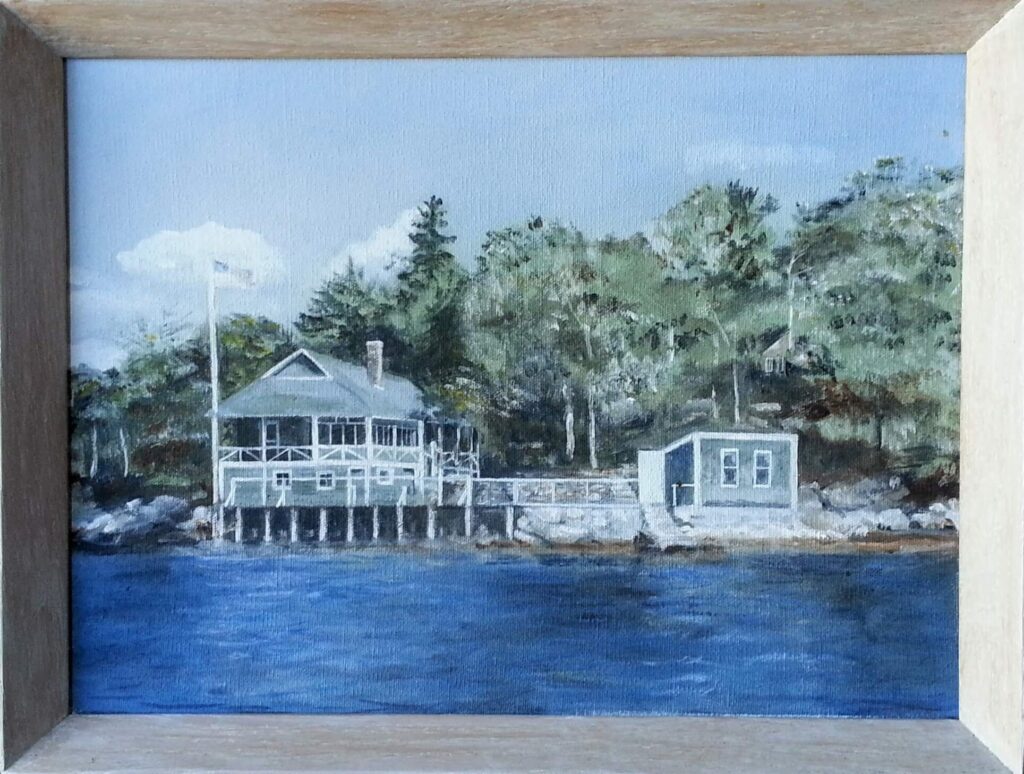
Mr. Seavey persuaded Mr. McKinley to sell him the Seanook lot. We think that the cottage was initially constructed over a hundred years ago, completed by 1910. From photographs dated 1920 we can tell that it was indeed looking then as it did 27 years later when my parents bought it in 1947. The genius of the original construction, not on the land, but next to it, was accomplished by Mr. John Seavey, who owned the East Boothbay General Store at the time. He developed it to use as another store front and also probably as a cooler summer retreat. It was built on rock fill in the lee of the turf covered ledge which was dotted with pretty grey birch. Our oak tree would have been much smaller then. Probably a bit later someone planted small spruce trees as protection from the dust raised by cars passing along the dirt road. They lasted until the advent of salt as ice-melt.
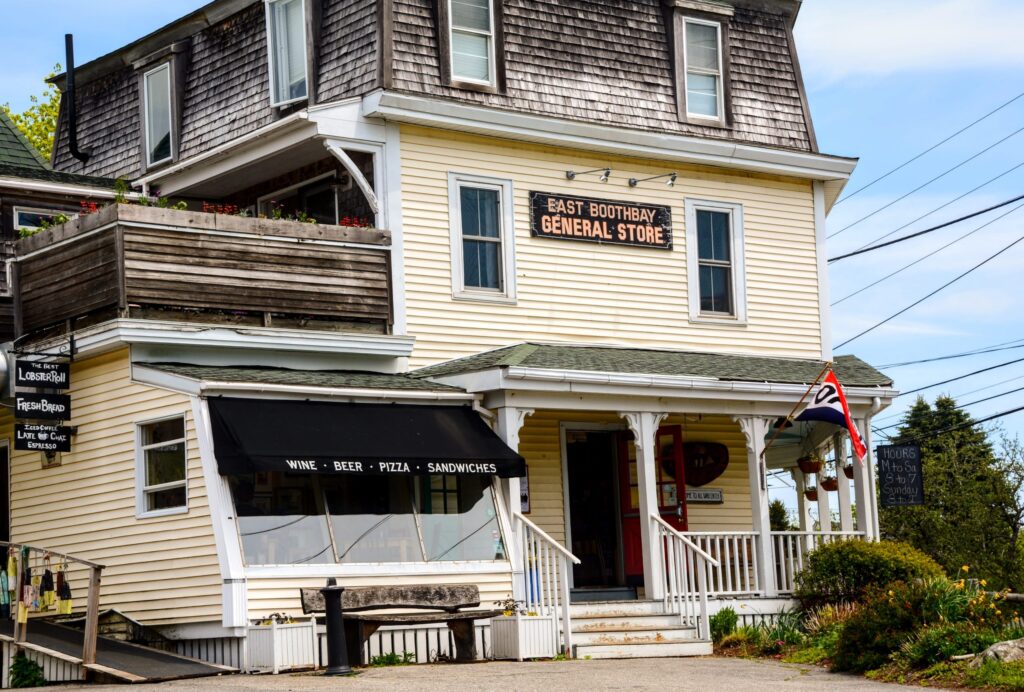
Mr Seavey built a dock that extended straight out, in line with the steps down from the lawn. You can still see the mounds of seaweed-covered rocks that held the pilings he put in there, so history is visible. As he made it, the wider lower deck, which was still there when I was little although the dock was not, extended three feet further west out over the water. The walkway went around level toward the shed where he stored cans of gas from which he sold fuel to lobstermen on the bay. He also sold them bait and snacks.
This shed was later called Hotel Astor. Probably the name came courtesy of Mrs. Everett (owner previous to my parents), who initially fixed it up as a guest room.
Mr. Seavey’s daughter, Jean Seavey, and her friend played in the woods on the flat rocks across the street from Seanook, as recounted to me by that friend, Virginia Stapleford, a sewing customer who came to me when I first moved here permanently in 1999. Probably in her 80’s at that time, she was quite angry that my house was built over her “play place!” but I think she may have played on the ledges just south of the cottage, because there are no flat rocks under the house.
Her friend, Mr. Seavey’s daughter Jean Seavey, married Victor Montgomery, becoming Jean Seavey Montgomery. The Montgomerys were an original family of settlers in East Boothbay.
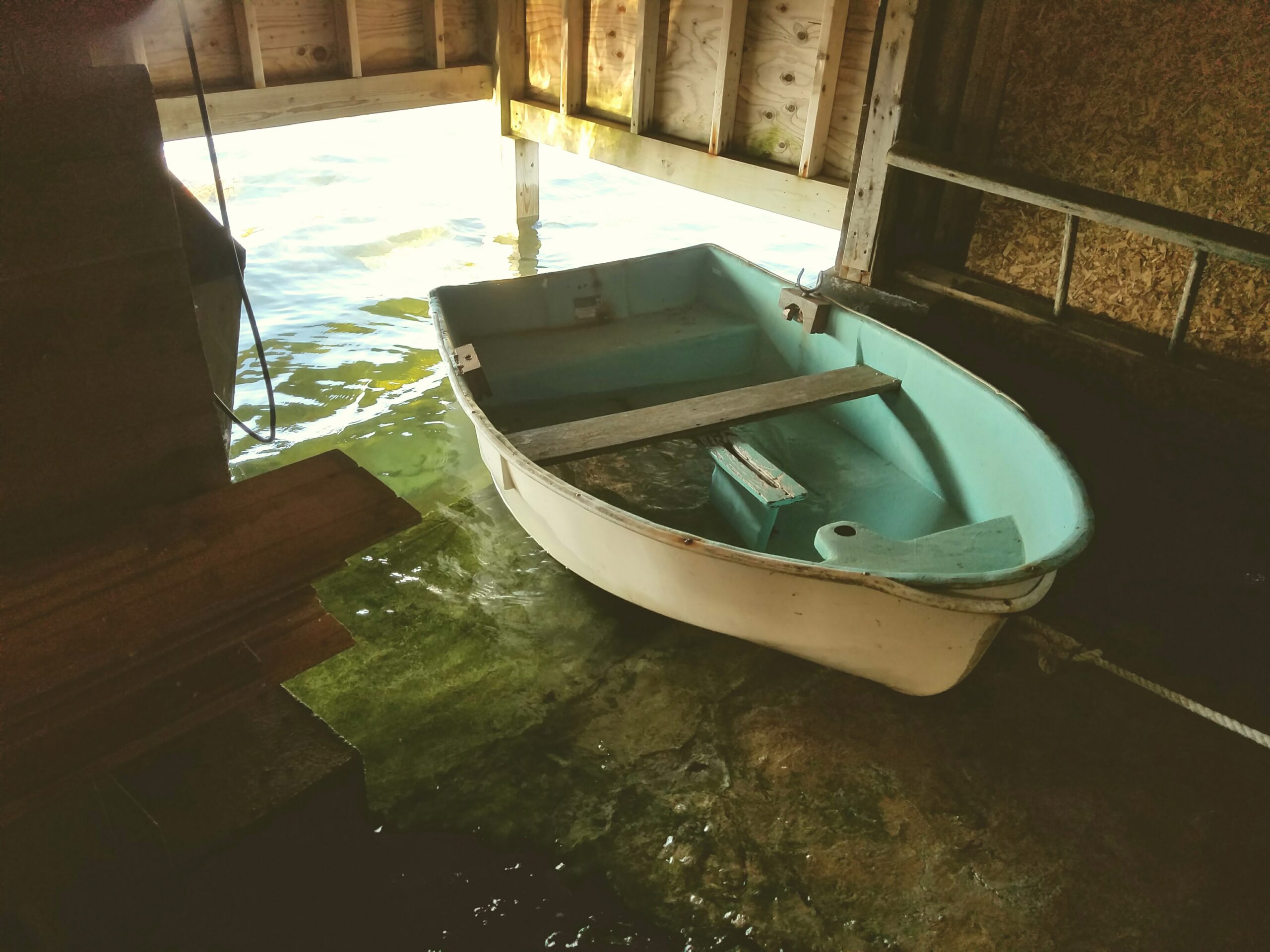
The underneath of Seanook as built by Mr. John Seavey, was intended for boat storage. The large front wall was hinged at the top and could be hoisted when you wanted to pull in a bigger boat. However, the low ceiling inside would have limited height anyway.
Mr Seavey’s daughter and her husband, Victor Montgomery, used the property for a number of years. When they were ready to sell, it was purchased by the Parker family. One brother owned the house next door, and the other bought our bungalow and the two lots across the road.
The Parker brother who owned our bungalow was the father of Mrs. Evelyn Parker Everett who inherited Seanook from him. In 1937, Evelyn’s husband, Eldon Everett, sold the two lots across the road back to Edward F. Parker, owner of the cottage next door.
The Boothbay area was known to my grandmother and mother, as it had long been a summer destination for Pittsfield families. My parents first rented a house that was later part of the Ocean Point Inn on the northside of that property. There is an old photograph of my mother holding my hand when I was small, probably 1½, in the water on the tiny beach across the street from that building. After that we stayed at Mizzentop for two summers. It was there, probably the second summer, that I famously scrubbed the railing top in my white flocked dotted swiss dress with red smocking, and did not get a drop on my pretty clothes! I remember from the stories that I was four years old at that time, and my sister, Beverly, was one. Dotted Swiss was a sheer cotton fabric with small fiber dots machine-glued on at regular intervals. “Mummie,” as we called my mother, probably did the red smocking by hand. She made matching dresses for my sister and me.
That same year my mother, Helen Hambleton Tiller, purchased the bungalow, complete with furnishings, through the realtor, Mr. George W. Linekin, whom my grandmother knew from Pittsfield. He had an office in a tiny building on the Ocean Point Road in what was later the Linekin Bay motel and cabins. My mother bought the Seanook property with part of her inheritance from her father for exactly $3507.15, including taxes and insurance for the remainder of that year! Interestingly, the original agreement on August 7, 1947, was between Eldon F. Everett and my father, Paul D. Tiller. Men were obviously the ones who conducted official business for their wives. The sale of the property was final on August 18, 1947, with a check to Eldon F. Everett, of Westwood, Massachusetts with the “agreement” of Evelyn P. Everett, as she was the one who had actually inherited the property. The Everetts had the right to stay through Labor Day of that year, so it was 1948 when we came for our first summer. I was 5 and a half and Beverly was 3.
I do remember that Mrs. Everett came to visit occasionally in the first few years of my parents owning the property; I think her husband had died by that time.
My father “came up with” (his words) the name “Seanook,” because this is a “nook by the sea.”
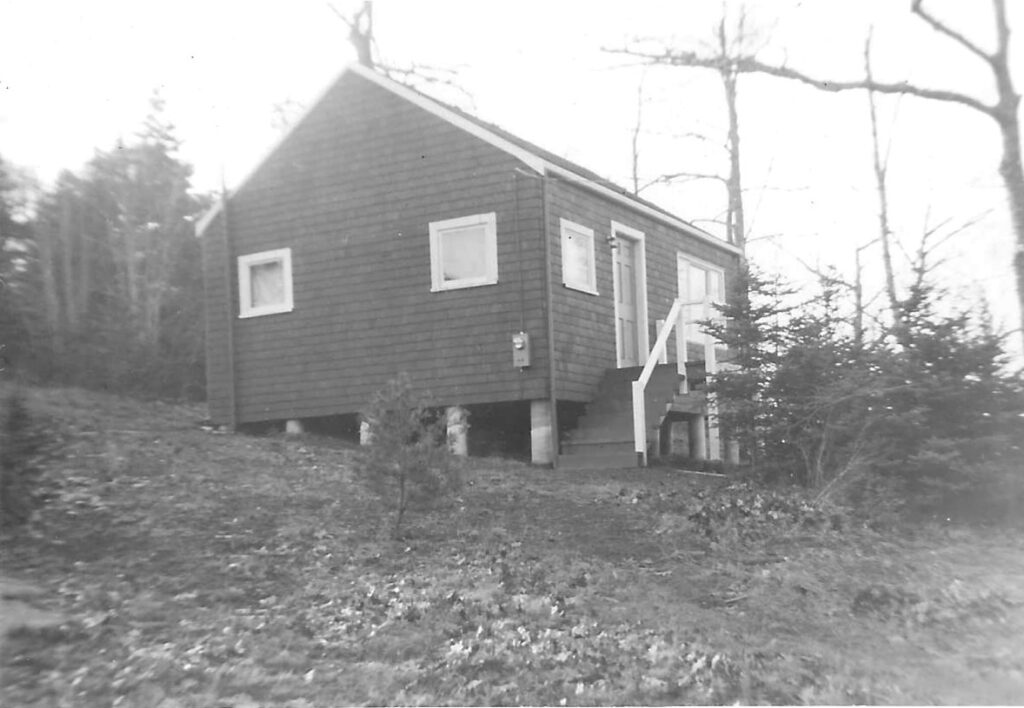
In 1951 for $500, my grandmother, Ethel Belle Vickery Hambleton, purchased those two lots across the street for her house, which she named “Woodhaven” (now Paradise Cottage) and sighted it at the southwestern most possible boundary for maximum view down the bay. My father put up the shell of the first square of the cottage for her in the summer of 1952. He had my mother up on the scaffolding holding up the ridgepole a few months after my brother was born. She was not happy about that!